Will the Floor Have to Come Up? Slab Leak Repair and Your Floors
It is the question behind every slab leak call: what happens to my floors? The honest answer is ‘it depends on the method — and you have more say in that than you think.’ This guide walks each repair method’s real impact on tile, hardwood, laminate and carpet, and how the floor itself should shape the plan.
Spot repair: a hole the size of the job
A spot repair opens the slab at the pinpointed leak — typically a modest opening, cut cleanly, sized to reach and replace the failed section. The flooring above that spot comes up with it: a few tiles, a section of wood, a lifted patch of carpet. The rest of the floor is untouched.
The real floor question in a spot repair is matching. Current-production tile and LVP usually match well; aged hardwood, discontinued tile and stained concrete are the hard cases — and they are an argument for the other methods, made before the saw starts.
Reroute: the floor never knows
A reroute abandons the buried line and runs the replacement overhead. The slab is not opened; no flooring is lifted, cut or matched. The disruption moves to a few small wall and ceiling openings where the new line runs and ties in — patched drywall, not replaced floors.
For homeowners whose floors are the home’s value — wide-plank hardwoods, book-matched stone, heated tile — a reroute is often chosen on this ground alone, provided the pipe’s condition justifies replacing the run.

Tunneling: work happens underneath
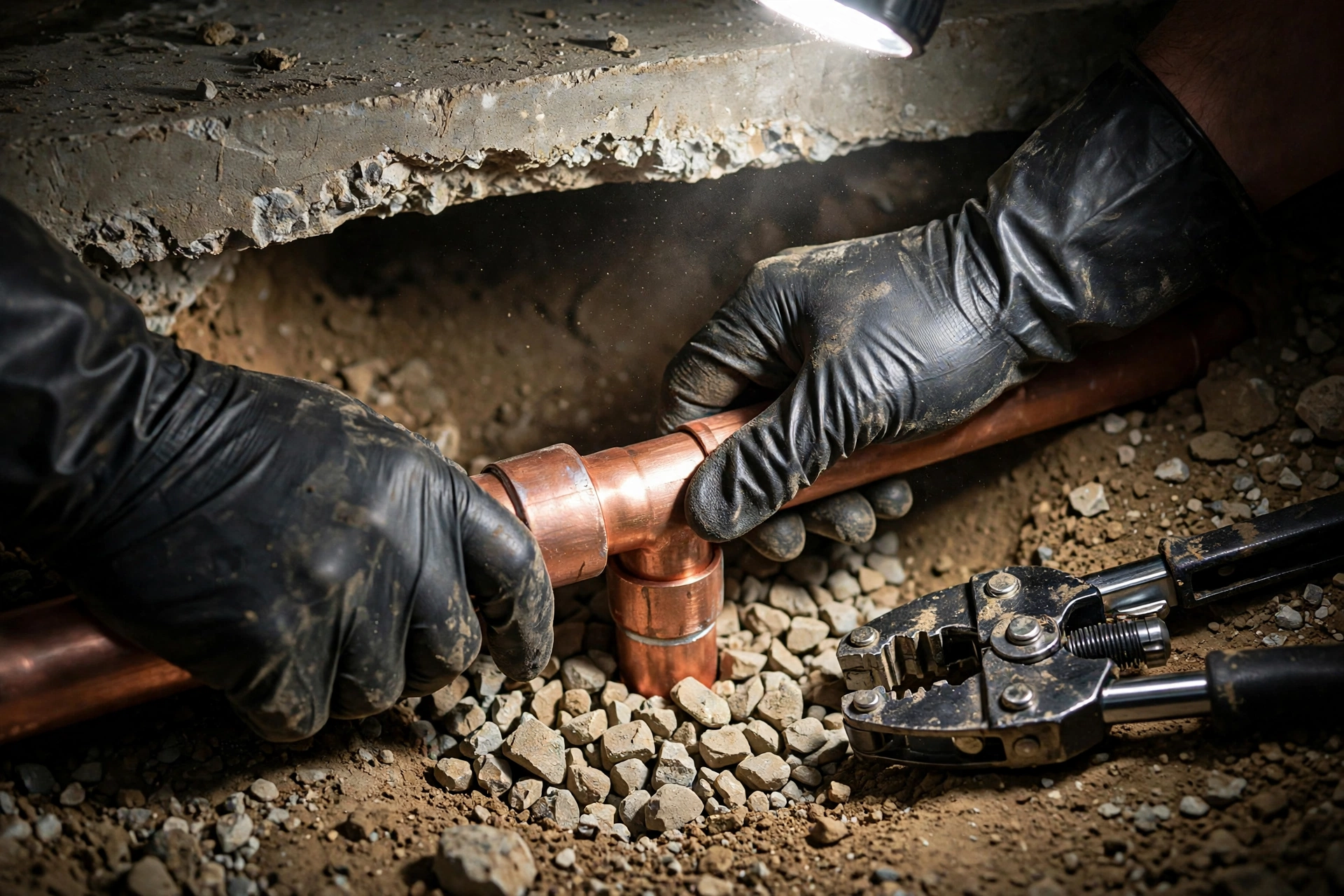
Tunneling reaches the pipe from outside, digging beneath the slab. Interior floors are entirely untouched; the visible disturbance is outside — an entry excavation in the yard, restored and backfilled in compacted lifts after the repair is pressure-tested.
Tunneling’s floor verdict is the same as reroute’s — untouched — with a different trade: yard restoration instead of wall patches.
What about the water damage already under there?
Separate the two floor conversations: the repair’s access impact, and the leak’s own damage. Moisture under flooring may require drying or partial replacement regardless of method — buckled laminate over a long-running leak does not un-buckle.
Your assessment should address both plainly: what the repair will do to the floor, and what the leak already has. Conflating them is how homeowners feel ambushed mid-job.
Making the floor part of the written scope
Before approving anything, get the floor plan in writing: the method, the exact opening if any, who patches what, and what matching realistically looks like. Photograph your floors before work starts — for matching disputes and, where relevant, for insurance.
A professional who has done this work in finished homes treats floors as a design constraint from the first visit. If yours is treated as an afterthought, that is information.
Only as large as the repair needs — typically a small, clean-cut opening over the pinpointed leak, not a trench. Exact size follows the pipe’s depth and the section being replaced.
If the tile is current production or you kept spares, usually yes. Discontinued tile is the classic mismatch — one more reason the method decision should weigh the floor’s replaceability.
No — the entry area is excavated and then backfilled in compacted lifts and restored. Expect a worked patch of landscaping to settle back over the following weeks.
Related Services & Guides
Have This Problem at Your Home?
Guides explain the problem — an assessment shows whether it is yours. One call connects you with an independent local slab leak professional in the Little Elm area.
Call (888) 555-0199 →Get in Touch with Us
The fastest way to reach a local slab leak professional is by phone. Prefer to write it down first? Send the short form — describe what you are seeing (a sudden bill spike, warm floor spots, the sound of running water), where in the home, and since when.