Slab Leak or Wall Leak? How to Tell Where the Water Is Coming From
Both hide. Both damage. But a slab leak and a wall leak are different repairs with different urgency — and homeowners regularly pay to chase the wrong one. This guide lays out the tells that separate an under-slab failure from a leak inside a wall, so the first professional conversation starts from evidence.
The location tells
A wall leak speaks at the wall: stains, bubbling paint or soft drywall on one specific wall, often vertically aligned under a bathroom, laundry or kitchen above or behind it. A slab leak speaks at the floor and the bill: warm or damp floors, meter movement, and stains that appear at floor level — baseboards swelling, flooring failing — rather than up a wall face.
Water travels, so location is a clue, not a verdict: a wall leak can drip down and present at the floor, and a slab leak’s moisture can wick up a baseboard. Patterns matter more than any single spot.
The fixture test
Wall and fixture leaks are often conditional: they appear when a particular shower, tub or appliance runs, because the failing line or drain only carries water then. Slab leaks on pressurized supply lines are unconditional — they run at 3 a.m. with the house still, which is why the spinning meter and the unexplained bill belong to them.
Supply versus drain matters the same way: a drain leak wets only during use and stops when the fixture rests; a supply leak never rests. Professionals isolate lines by pressure precisely because symptoms overlap.
The sound and pressure tells
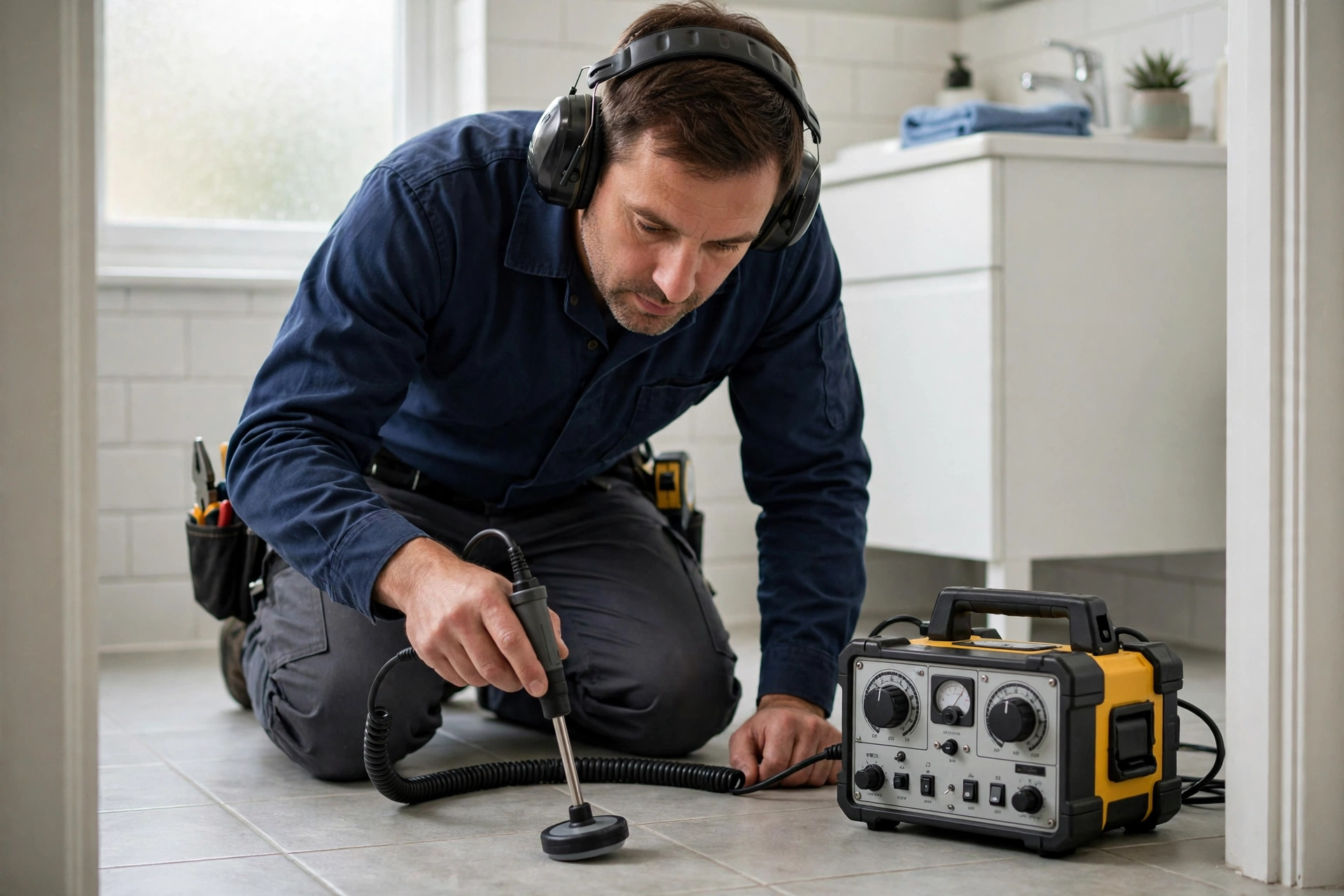
A hiss localized inside one wall section, louder with an ear to the drywall, suggests a wall-side supply leak. A diffuse murmur underfoot, or sound that will not localize to any wall, points below. Pressure loss across every fixture in the house fits a main-side under-slab failure; one room’s worth of trouble fits one room’s plumbing.
Neither test is conclusive alone — they triage. The conclusive step is isolation and pinpointing, which is assessment work, not guesswork with a saw.
Why the distinction costs money
Open the wrong structure and you pay twice: drywall explorations that find nothing, then the slab work that was needed all along — or slab holes hunting a leak that lived in a wall. The sequence exists to prevent exactly this: meter and pressure evidence first, pinpoint second, opening third.
Be wary of any quote — for either repair — given before the leak’s location is proven. Confidence is cheap; holes are not.
Your next move, either way
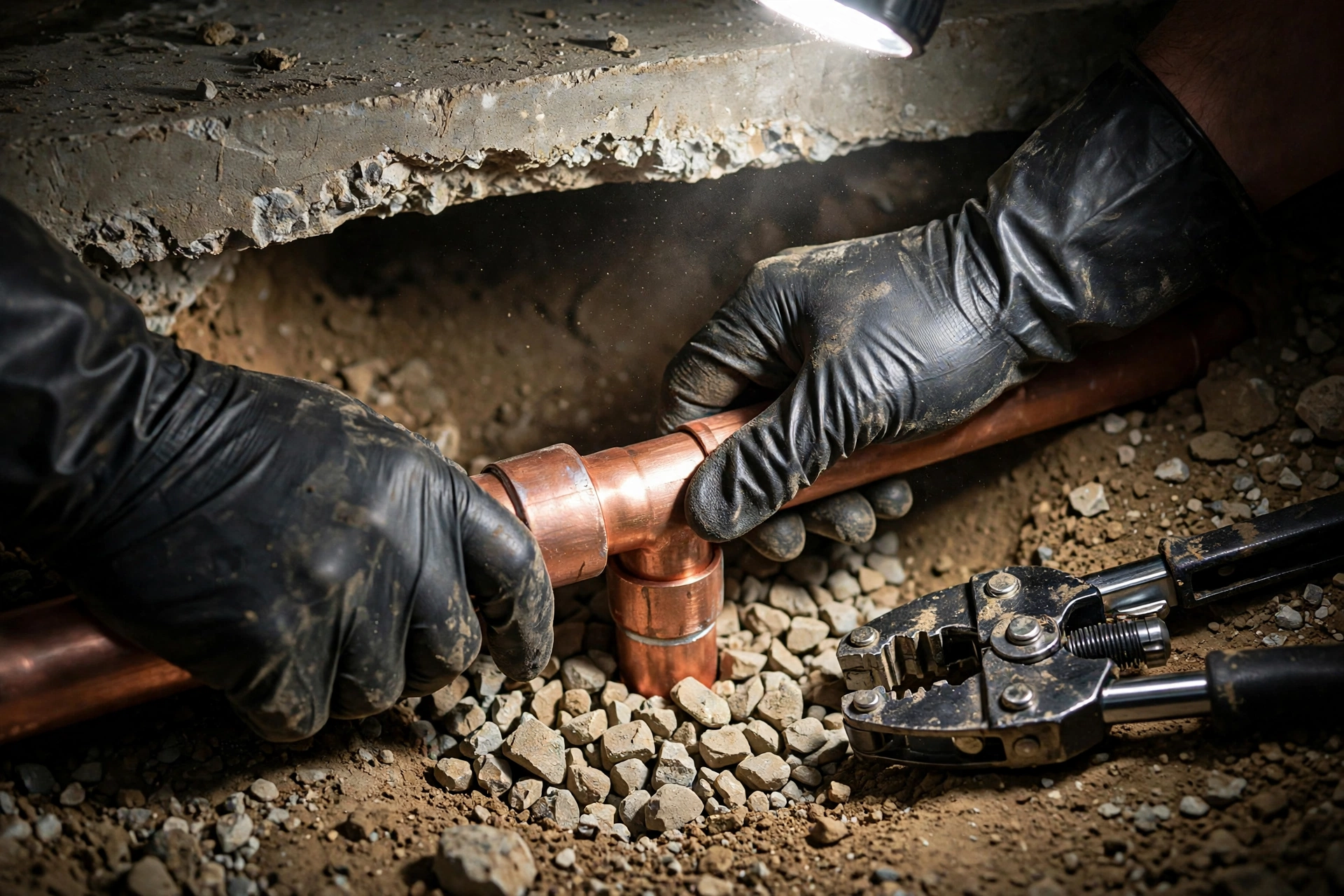
Whichever leak yours turns out to be, the first moves rhyme: shut off water if damage is active, document the symptoms and their timing, and get the location proven. If the evidence lands under the slab, the method conversation follows; if it lands in a wall, you will have saved yourself the wrong crew and the wrong holes.
Start with the evidence you can gather tonight — meter, bill, fixture patterns, and where the signs live in the house. You will be surprised how much of the diagnosis it already is.
Yes, if it is a pressurized supply line inside the wall — it runs constantly too. The fixture test and localization are what separate them, not the bill.
Swelling at floor level fits both a slab leak wicking up and a wall leak dripping down. The pattern around it — floor warmth, meter movement, which wall, which fixtures — decides; the assessment proves it.
By isolating sections of the system and pressure-testing, combined with acoustic and thermal pinpointing of the exact failure point. Proven means a location a repair can be planned around — not a neighborhood of guesses.
Related Services & Guides
Have This Problem at Your Home?
Guides explain the problem — an assessment shows whether it is yours. One call connects you with an independent local slab leak professional in the Little Elm area.
Call (888) 555-0199 →Get in Touch with Us
The fastest way to reach a local slab leak professional is by phone. Prefer to write it down first? Send the short form — describe what you are seeing (a sudden bill spike, warm floor spots, the sound of running water), where in the home, and since when.